The first we cannot really say
What did it mean
How could it be
Why are we in this ruffled fray
Yet here we are
Going too far
Knowing no other way
We sue for peace, at least we think
Then boom
No room
For time to sync
Thrust in
Can’t win
Our part in ink
No one wants war, we always shout
Yet fight
With might
Our truth, no doubt
We’re right
Despite
The others vows
Where is the middle, no one know
Don’t shove
Just love
Help others grow
Yet rot
Let not
Bad ideas show
Whose wrong, well that is hard to say
For both attack
Then both fought back
We’re no longer in child’s play
If one starts
other takes part
Then both children should have to pay.
But children this whole thing is not
Lost lives
Lone wives
Is what we’ve got
No homes
Can’t roam
The weary’s lot.
From comfort of a stable house
We make calls
What will fall
Then kiss and hug our loving spouse
The crash
Don’t last
Our doors don’t rouse.
But threatened by a foreign place
Sit back
And laugh
Keep out they say
Before
No more
The towers grace
Do we know, no other way
This fate
Our gate
For other days
Lean in
And win
I’m not so sure
For minds we must have of our own
We cannot
Will not
Merge to be known
We cannot
Will not
Fight alone
Yet cannot
Will not
Join the throng
What does all this rhyming mean
A thought
That’s raught
Placed on the scene
A call
To fall
In own regime
A call
To fall
In your own place
A call
To stick
To your own faith
A call
To stand
For human race
The Wrestle
Many years ago, an ancient Israelite prophet was born. Not just any man, but the namesake of the people. He lived his life cunningly and became rich in the things of the world. When standing at the face of destruction or victory, one of those weird biblical stories happens to him. He wrestles with a man, dislocates his hip, and is blessed by God.
When your name is the same as someone else’s, there’s always a sense of comradery. You don’t have to know anything about them. You have a default similarity that unites you. It doesn’t mean that connection will last longer than an introduction, but it’s there. Hence, an interest in the ancient Hebrew prophet Jacob. He was a man like many others who sought after the pleasantries of life.
When Jacob was young, his older twin brother returned from the fields tired and hungry. Jacob, who was in what could be loosely be described as a homebody, sat with food he’d spent some time making. Esau, the elder twin, begged his brother for some food. Jacob, whether in jest or seriousness, told Esau he was welcome to it, at the price of his birthright. Esau, annoyed but too tired to care, agreed and ate selfishly.
This single event defined the beginning of Jacob’s life. Later, he and his mother would trick his father into giving him the birthright blessing in place of Esau. He would flee to his uncle Laban, where he met Rachel, the most beautiful woman he’d ever laid eyes on. He convinced Laban to let him marry Rachel for seven years of labor. This led to one of my favorite descriptions of love for a woman in the bible.
“And Jacob served seven years for Rachel; and they seemed unto him but a few days, for the love he had to her.”
Now Laban was almost as cunning as Jacob. Through some trickery of his own, he caused Jacob to marry his elder daughter instead of Rachel. After realizing the deception, Jacob worked another seven years for Rachel’s hand in marriage. In the next years with Laban, Jacob would use his own cunning to gain many of Laban’s flocks, building up his wealth until eventually being called back to his homeland by God.
He would return a wealthy man of his time in many regards. He had many wives and many children with flocks he’d gained from his labors with Laban. Only one roadblock stood between him and his ultimate glory, Esau. His trip home was filled with distress for this uneasy reunion. What would his brother do with him? It didn’t help hearing the hosts Esau planned to meet him with. Jacob sent gifts ahead, hoping, pleading it would be enough to stave of the anger from all those years before.
The night before their reunion, Jacob encountered a heavenly visitor. This is not the same as the dreams that have guided him in the past. He and this “angel” wrestle for a time, dislocating Jacob’s hip and resulting in one of them getting pinned. It’s not clear who was pinned, but whoever prevailed refused to release their opponent without receiving a blessing first. Here, Jacob was blessed and received a new name.
That day, Jacob reunited with his brother, who welcomed him with open arms. From that day, though he saw sorrow, he was blessed by the Lord.
What can we make of this encounter? To wrestle with God is not an uncommon analogy, but to dislocate your thigh doing so?
Each story in the Bible holds symbolic meaning. Whether the events took place or not, the story tellers integrate eternal truth so they may be ingrained in the hearts of the fervent listener. I believe that night Jacob did wrestle with God, but it was not a physical encounter. For instance, the Hebrew phrase used is “gid hanasheh”, a reference to the sciatic nerve. What can cause issues with that nerve? Kneeling through the night probably isn’t great.
Esau represented all of Jacob’s deception. He’d bought the birthright and stolen it from his blind father. In many regards, Jacob probably wondered if he was truly capable of receiving the blessings of his father. That night was a night he knelt before the Lord in repentance. He was terrified of not being forgiven by his brother, and it was that terror that turned him to God. If God could forgive him, maybe everything else would work out.
Now, the moment of pinning. The scripture says “he touched the hollow of his thigh” This was the moment Jacob felt the weakness in his legs begin. Yet, Jacob refused to stop. The spirit of God even recognizes this weakness and demands to be released from his pleading. The fact this heavenly being doesn’t simply leave gives the hints of a test being presented to Jacob. Now that you are weak, will you let me go?
How often do we fall into that ourselves? We put our best foot forward to God, but when our legs are tired, do we let him leave us behind? For Jacob, the spirit of God would not leave him, and he demanded a blessing. What was that blessing? According to him, he saw the face of God. It was that moment Jacob became a witness of God in a way many could only hope. Up till that moment, God had spoken to him through dreams and the revelation of his parents.
Jacob became forever bound to the Lord. That sacred moment of covenant between God and man came as the messenger placed hand on thigh, a binding covenant only used two other times in the Bible. The moment between Abraham and Isaac when Isaac covenants not to marry a Canaanite daughter, symbolic of man’s covenant to forsake the things of the world. The other is Joseph’s covenant to Israel that he be buried in the land of his father’s, symbolic of our own return to God after death.
Jacob’s own covenant is given through his new name, a symbol of becoming a new person through God. Israel, to strive with God, to persist with God. It’s the covenant Jacob makes to walk with God in this life. It’s the covenant that ties the three together. We avoid the things of the world and walk with God with a promise that when we die, we will return again to the promised land, the land of our Father.
Low Reserve
Lately, I’ve been spoiled. I had a spout of writing vigor that allowed me to write multiple blogs in only a few days. That writing did its job by reinvigorating my creative writing. I’ve been able to move back to my book and expand on lore. The challenging side is that precious gem of time. I don’t always have time to write a blog and expand my story.
My initial goal of writing a blog a day was quite daunting. That was committing to sitting down at least once a day and writing out something that had to be more than just a couple of sentences. It also had to contain some sort of context that had meaning to me. I thought I would struggle, but the goal just strengthened my desire. That first day, I think I wrote three different blogs. Afterward, the words just seemed to flow out. By the third day, I had at least five blogs ready to publish.
Realizing how much writing I could accomplish, I started returning to creative writing. I could write a blog and then work on a story. The reality of it was I’d had a few easy days at work where my mind was free to express itself on breaks. In the following weeks, we got pounded with weather, turning something that could generally be uneventful to a mix of complexity. My brain was exhausted. Suddenly, spare time was used for resting the brain rather than using it to write.
Creative writing is a great outlet. It helps my mind rest while also allowing me to write. So, in my spare time, turning to creative writing was the thing that kept me writing. Now, I find myself reaching deep into the wells of my mind to keep both a blog writing habit as well as a creative writing space. It’s picking back up again, though.
Back to Basics
Apparently, my goal with this blog was a journey of my writing experience. It evolved quite a bit over the years as I’ve had to change focus on things outside of writing. Looking back l, now I remember all the intricacies of writing and how I wanted to keep a journal of sorts of my work through the story. What was once a simple story of a boy turning into a leader evolved into a world with an intricate history and expanding way beyond the land the story takes place in.
Writing is beautiful because it solidifies moments in time. It’s like taking a picture of your thoughts. Reading my own words of the past is like flipping through an old photo book and seeing baby pictures. With thoughts, these experiences can get even deeper, and on this occasion, my original plan for this blog was revealed. This blog was meant to be a back and forth as I thought about different paths for my story.
The blog has changed as I faced new things. Originally, it was accompanied by my story. I’d blog along with writing a chapter. After some changes in work and situation, the blog became a lifeline for my desire to write, simply containing moments in time of the simplest inspiration. After a time, I was greatly affected by my wife’s situation and too worn down to have a proper outlet. The blog became an outlet for that burden, allowing my mind to open up and express itself again. Most recently, my blog has been filled with a mix of random thoughts, inspiring studies, and poems.
This has been wonderfully powerful in pushing my writing forward. I’ve been able to break through a lot of barriers that slowed my writing down, knowing all I have to do is think it, then write it. This long journey has come round again, as it will likely do again. I’m back inspired by my old words and stories. I find myself again laying out timeliness and plots. All these thoughts can be overwhelming and easily forgotten, but by tracking these thoughts through blogs, I can better evolve them to their proper end.
I don’t intend this blog to become entirely enveloped in my story. In fact, I still have a well of topics that have yet to be written out. I hope I might move closer to the roots of this blog by drawing it closer to the book I have worked many years on completing. Perhaps the day will come. I can publish my book, and this blog will be a biographical record of what makes writing take so long.
Personal

When I started writing this blog, I never wanted to get too deep into myself. I don’t mind sharing my own experiences and the emotions behind them, but there are some things that reveal themselves while writing that I realize is a little deeper seeded than I’d known. Yesterday, I started writing a blog on something I thought was a simple observation, then realized it was much deeper than that.
The line between what’s personal and what’s private is not always well defined. My year last year, with my wife’s health struggles, was very personal, and the emotions were all over the place, but I actually felt a need to share it. Not only was it a release to a lot of internal pressures on me, but it also allowed my wife a glimpse into my mindset. To a degree, it was kind of like getting ready to go to the pool. You know what you’re in for. You know exactly how much of you will be exposed, and you know most of the other people around you will be equally exposed.
The private stuff is weird. I wouldn’t say the things I wrote were any more or less than my feelings of last year, but I just wasn’t prepared for them. I’d equate that to a dream about going to work or school in your underwear. You’d expose yourself just as much as if you’d gone swimming. It’s just the situation and lack of preparation. That’s how I felt as I was writing. Suddenly, words were coming out that exposed a deeper feeling I hadn’t realized (or kinda had on a different scope) I was having.
I think I’ve mentioned how writing helps me process a lot of feelings. It has been great for my mental state. This has been the first moment I was clearly writing about something deeper than I’d realized. I mean, it began with a realization I was the only dad with their kids sitting in a cafeteria full of moms and turned into a much deeper emotion.
I think underwear and swimsuits are perfect symbols of personal and private. They both cover nearly the same amount of your body, but one you wear expecting to share, the other you wear not to share. Two items, nearly identical, yet represent two sides.
Chekhov’s Gun
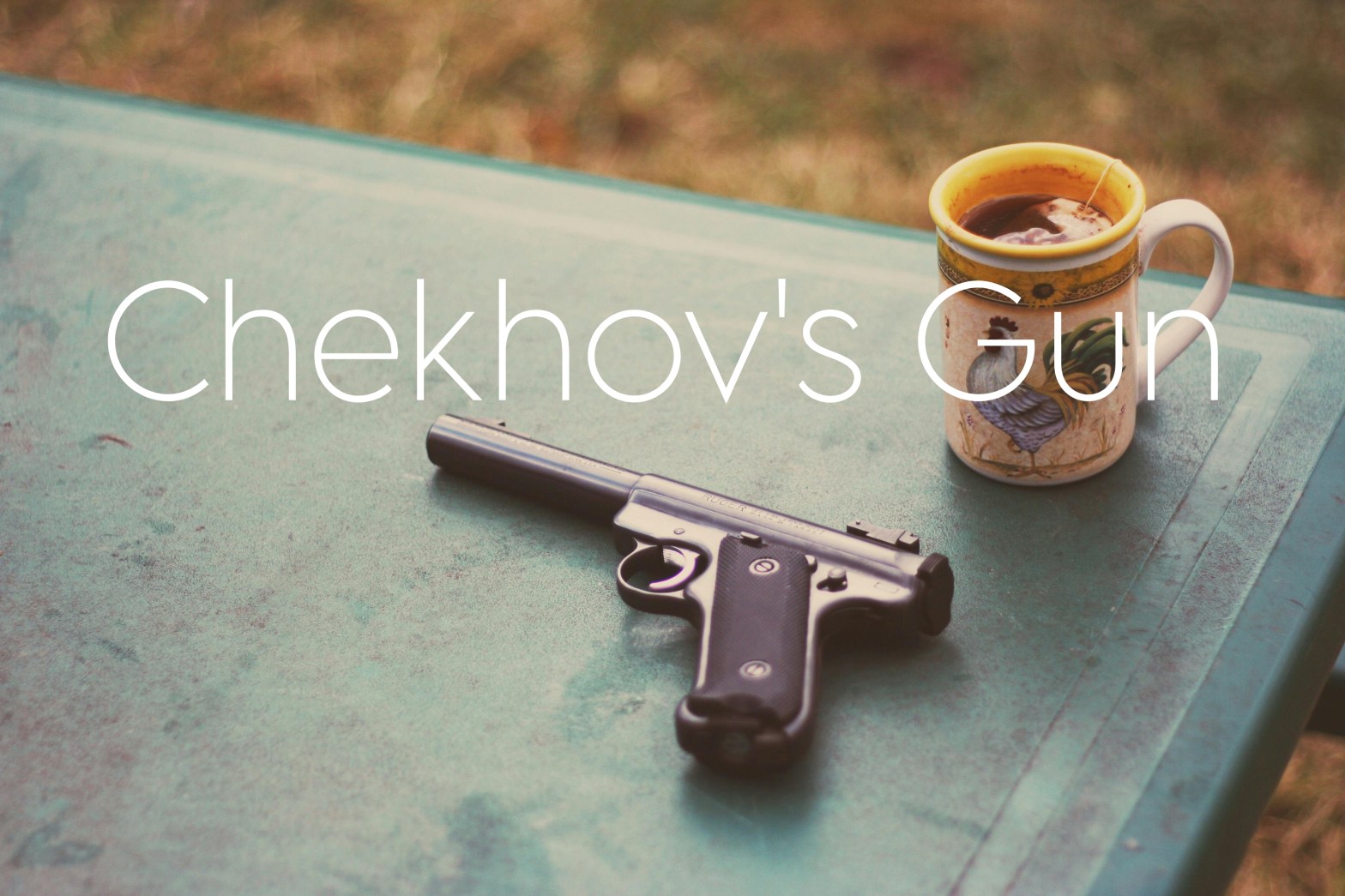
“If in the first act you have hung a pistol on the wall, then in the following one, it should be fired. Otherwise, don’t put it there”
Anton Chekhov
Writing a story is an incredibly fun activity. You get to create a whole world from nothing. You have a million things to reference and nothing to restrict you beyond your own imagination. Your world can have your beliefs or beliefs that don’t even exist. Despite the freedom, there are nuances that exist within the fiction world that create fictitious restrictions on one’s imagination.
Writing was Minecraft for me. When I was young, I wanted to create the most life-like video game. A game where every decision made a different character, where you could almost never experience the game the same way twice. I realized that what I wanted to do was create my own world of fiction. Writing wasn’t always easy. How do you describe a creature that doesn’t exist in the real world without referencing something in the real world, because in your story, that is the real world. I think Tolkien did a great job when he introduced the idea that his story was of ancient England. This tied his characters to our reality, making it easy to bring the two worlds together.
That became my new barrier as a kid. The world was my oyster, as long as I could describe the oyster. For years, I’ve thought about how to make an audience feel words. I studied how people wrote descriptively. I read back my own words, seeing if I could taste the rainfall or feel the icy wind whipping past. For a time, I even felt like I was getting quite good at it. In fact, I know there’s such a thing as regression because sometimes I’m taken more in by how I used to write than how my words come across now.
Mastering a descriptive language is a great skill, but another one eluded me. Object importance. I would write about a sword, describing its shining jewels, the glimmering silver, cool to the touch. Its blade engraved with ancient text no one could decipher. Four chapters later, the sword is gone. It took a lot of time for me to start listing items of importance. Then, my mind became caught up in this quote above. Every item suddenly became important. If I mentioned an unusual feature, suddenly it meant something deeper. If my character caught a glimpse at the hilt of a sword, that sword had deeper meaning. I became almost obsessed with each item, meaning something.
That’s when, interestingly enough, I stumbled upon a Quentin Tarantino interview. He spoke about how including details that allow an audience to think, “hmm I wonder what that’s from” gave a deeper meaning to his stories. So now when I see this quote above, my mind always counters it.
I place the importance of each item in the middle. I don’t believe a story is incomplete if an item doesn’t fulfill its purpose within the story. Sometimes, a sword is just a sword. A book is just a book. As a story writer, I get the extra ability to have meaning behind it that I know that isn’t expressed in the story itself. For instance, I try to come up with a detailed back story to each of my characters. Some have their life before the story alluded to others, and you don’t get any reference to their past. Sometimes heritage exists that links to great leaders, but the character with the heritage plays a little role.
The reality is that nuances are only that, nuances. Just because something works for the masses doesn’t mean it will work for you. Just because something doesn’t work for the masses doesn’t mean it won’t work for you. Some of the greatest stories of our lifetime haven’t followed the structures of their time, yet we loved it, and our love made it great. So stay creative, stay imaginative, don’t let the advice of success restrict your own story. Your story can be great they way you want to tell it.
The End
You know what I’m really bad at? Endings. With all the blogs I’ve written, when I finally reach the end, I’m not sure how to wrap it all up. Do I do the classic essay where I just repeat the lesson from the blog itself? Do I give some sort of inspirational message? I’m never sure exactly what would be the best wrap-up.
Each time I write, as much as it might not seem so, I think about how I’m going to write. Typically, I take my first paragraph and write general thoughts, and then each proceeding paragraph expands on those original thoughts. Doing this, I feel like, builds a cohesive blog that is easier to follow. Maybe I’m wrong, but that’s my intent. That’s just where the ending becomes challenging. If I do a nice little wrap-up, typically, it would just be a repeat of the first paragraph.
I remember taking writing lessons and really enjoying the moment I could create a good essay. The end of an essay, though, is easy. Your audience is your teacher. This final paragraph is your moment to shine. You get to put it all on the facts in the most simplistic terms to brag about your findings to your teacher. That’s what it is, though, bragging about learning. Your teacher essentially asks if they agree or disagree with what you’ve actually learned. Here, that always feels a little weird. Mostly because I’m not necessarily sharing a lesson as much as letting words just spill out.
That’s also what makes giving some sort of inspirational quotes hard. I’m not trying to teach some profound lessons with my blogs. I don’t intend on giving advice to people. My blogs are for myself. Having them available for others to see allows some sort of lock in my brain to break and keeps me writing. Who am I to try and inspire people onward? I even have a specific blog in the works expanding on this idea that I’m no scholar.
So here we are again. At the end. Maybe it’s the fact that I feel like I could keep writing. I think if I had enough time, I could break it all down a lot more. At the same time, I feel like there’s not much more to explain. I mean, this whole blog is about how I don’t know how to end a blog. Did I ever really need to write more than that sentence?
No Degree

Sometimes, writing a blog feels weird. Not because writing is weird or even sharing a bit of yourself online. It’s usually the last little portion of the blog. That, I learned something, portion. It’s not always there, but when it is, you suddenly feel like a teacher of sorts. You’re giving your advice to whomever decides to read. To be fair, what you’ve learned is profound to you, but there’s always that little voice in the back of your head wondering what qualifies you to give anyone else advice.
I wrote an entire blog on how difficult it is to come up with a good ending to a spray of thoughts. A lot of that is tied into the idea of “final lesson” moments. When you have this journey of writing, at the end of the road, you want to wrap up your lesson with a nice bow. Do you really want to give other people the same lesson? What if you’re the only idiot who hasn’t figured it out yet? Those last words you want to be impactful, but you also don’t want to come across as too philosophical.
Maybe you do want to be philosophical, but for me, whenever I start to fall into that philosophical zone, I say to myself. “What authority do I have to say this”. Maybe that’s a strange idea to some people, the idea of being concerned with authority to speak. I mean, honestly, it’s a personal blog where I can say whatever I want. Words mean something to people, though, and I’m careful to make sure my words impact people positively. I wrote a blog about how a moment can change your life. Well, can’t words do the same? How many people have been changed because of words on a page? Everyone at some point?
The thing is, all the lessons I learned. Any inspiration that might appear as such is just a personal awakening to a new idea. It’s all for my own growth, and writing about it just allows that lesson to be locked in. Not only does it let my mind expand on the lesson, but it also allows it to be etched in (digital?) stone to review. Lessons that might only last a moment can last much longer, knowing I can look back and see the moment of inspiration.
So I may not have anything that qualifies me to give advice. I don’t have a fancy degree that says “listen to me!”. I’m not writing to try and inspire in anything more than that someone might chase a dream because I’m working on mine. If my words inspire you, I’m grateful we can connect on that point. If not, I’m not claiming to be a philosopher with overwhelming knowledge of every subject I write. I’m just me.
Beach Day

Run to the car screaming hooray
We’re going to the beach today
The sun just up, the air so cool
So happy to be out of school
We stop for drinks to get us by
Our favorite fast food passes by
“Please daddy stop” we always shout
And this time we drive up, get out.
In the sand we rush ahead
Food can wait we always said
We splash and play, then call for mom
Who talks to dad then strolls along
When finally through our first wind blown
To the table with lunch now drawn
We eat so quick, and now renewed
Back to the dirt where castles strewn
Finally as the sun now set
We grab our toys, our towels, our pet.
Tired we load up inside
Snuggled close with tired eyes
In an instant we are home
Carried to beds all nice and warm
Father rubs his tired arm
Stretches legs now stiff and warn
Rubbing tired droopy eyes
They gather all the things inside
A midnight rinsing of the pet
The sun now hours from its set
Washing shoes and toys all strewn
Throw out food, wince at the view
Daddy eats, while mommy yawns
Wondering where the time has gone
They talk of tired wishes long
As washers done and laundry’s drawn
Finally now they make the bed
A sandy child there sprawled instead
Pick him up and move him out
“I love you” says the little sprout
When you return she gives a sigh
The bill on the receipt is high
Set your alarm and prep your tools
You can’t be late, that is the rule
“A good day at the beach today?”
She smiles right back and says “hooray”
Just Ideas

One of the great things about writing a daily blog is inspiration vomit. Any thoughts that pop into your head suddenly become a grand new topic you can write about. Not only can you write about it, but you have a purpose to study it out more, analyze your thought process, and expand on how it affects you personally. The downside of these wonderful ideas, they come at random times, sometimes extremely inconveniently.
I wrote a blog recently, not sure if its posted, about ideas popping into your head at midnight and the difficulty of trying to remember them the next day. The other day, I had an idea pop into my head in the middle of a movie, and it was awesome, except because I was watching a movie, I didn’t write it down immediately. Now, as I sit and try to recall the exact thought, which I must remind you, it was awesome. It’s not quite the same. So here I am, left with a subpar idea, knowing it was something much cooler only moments earlier.
Part of this idea process is the note taking. Initially, I would think of an idea, write a title, and then come back to it, hoping I would understand myself. I was wrong. More than once, I sat looking at an obscure title and just thought “what in the world was going through my head?”. So I reverted to adding a brief description of why I had come up with the title and the thought that inspired it. It’s worked out great, although I admit it’s a challenge writing from old inspiration.
What I’ve been left with is a plethora of ideas and only a few fully written out blogs. The other day, which is the phrase I will now have to use because I don’t know when this will get posted, I was looking for a post to blog and realized I only had two or three blogs that had fully been written. The other fifteen ideas were just that. A single sentence written on the page, begging for explanation.
So that’s what I’m left with. A folder full of ideas waiting to be expanded on. It’s nice to have them all ready to go, yet daunting to think of how little I’ve actually been able to expand on the many thoughts that race through my head. I won’t stop now though. After all, I am inspired by Stickers and I can’t get a streak going if I stop writing now.
 Jacob Gittins